Essential preferences
Required to remember your cookie choice and support core site behavior.
Technical SEO, AI search visibility and custom development for businesses in Coventry, with a Coventry bodyshop as the measured proof.
I do technical SEO and web development for Coventry businesses from Nuneaton, about twenty minutes north of the city. The clearest proof I have is a Coventry bodyshop site I built and optimised: in the three months to early October 2026 it had 1,670 clicks and 204,000 impressions in Google, and when you ask Google's AI Mode which bodyshop it recommends in Coventry, that business is the first name it gives.
Mirage Bodyshop repairs vehicles in the Coventry area. I built and optimised their site on a custom PHP CMS I wrote, with on-page SEO scoring and auditing built into the application itself, so a service page is checked against the same standard before it publishes rather than months later when someone notices the traffic never arrived.
Its first three months went from close to nothing to 612 clicks and 56,700 impressions, at an average Google position of 14.4. The three months to early October 2026 reached 1,670 clicks and 204,000 impressions, at an average position of 12.
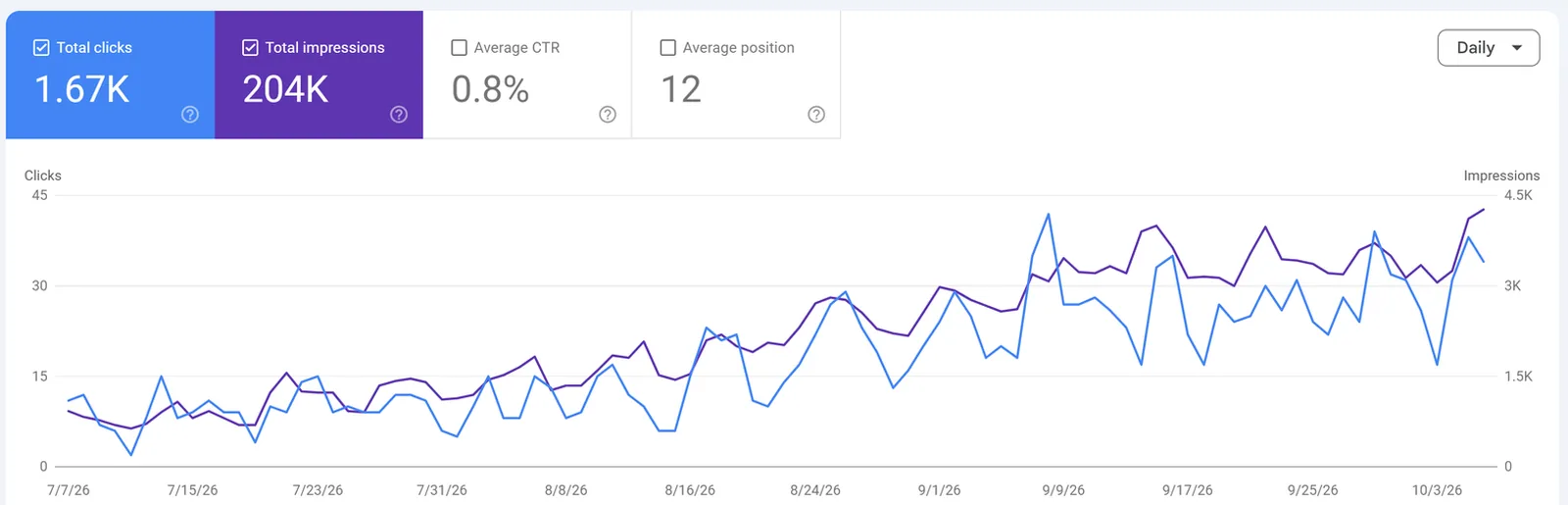
Look at that last number properly. An average position of 12 is still page two. In classic search, page two is a rounding error; almost nobody scrolls that far. And yet ask Google's AI Mode which bodyshop it recommends in Coventry and that site comes back first, by name. Same pages, same words, two completely different outcomes, because the two systems are not doing the same job. Google's blue links rank documents against a query. An assistant reads pages and decides which ones it can safely repeat out loud.
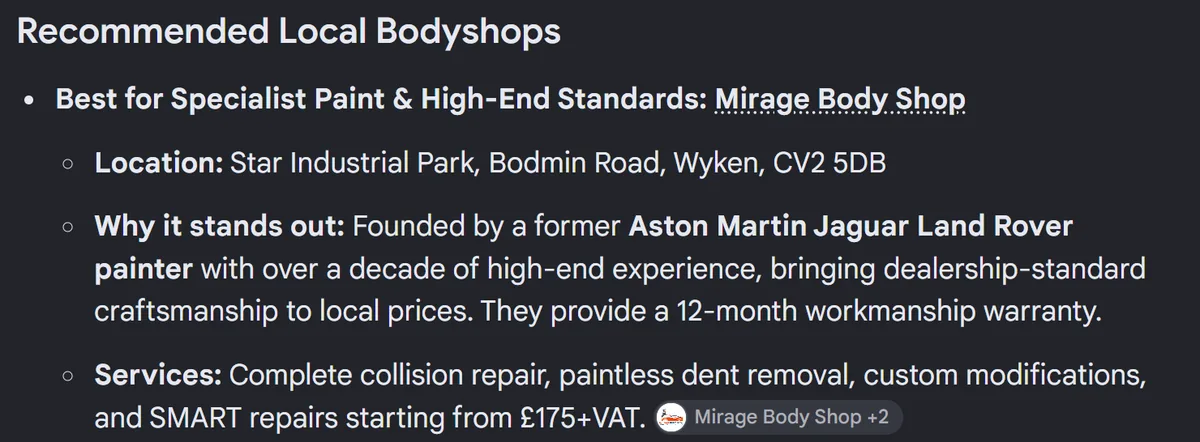
A results page gives you ten links, then ads, then a map pack, then more links, and a determined user can keep scrolling. An assistant asked for a bodyshop in Coventry names two, three, maybe five businesses and stops talking. There is no "show more". No pagination. No page two to be buried on. If you are outside that shortlist you are not merely ranked lower, you are absent from the conversation, and the person asking never learns you exist.
Getting into that shortlist is a different task from climbing to position three. The model is assembling an answer out of sources it can parse, cross-check and quote without embarrassing itself. It needs a sentence it can lift. If your services page opens with "our dedicated team is passionate about delivering excellence to customers across the Midlands", there is nothing in there to quote. If it opens with "we do alloy wheel refurbishment, paintless dent removal and insurance work across Coventry and Warwickshire", the machine now holds a fact it can attribute. Facts get cited. Adjectives get skipped.
Structure is what makes a fact findable. Assistants pull from pages, and often fetch them live to check, so how a page is built decides whether your claims survive the trip. Then it corroborates: does the site say the same thing as the Google Business Profile, the directories, the review pages? Contradict yourself across three sources and you become the risky citation, which is the same as being no citation at all. If you want to see whether any of this is already happening for you, Search Console has started reporting on it, which I walk through in Search Console's AI visibility reports and what generative traffic actually looks like.
You also get some say in how your content is used. The rules, headers and opt-outs available to UK site owners are covered in the practical guide to AI search controls for UK website owners, and the direction of travel is set out in what Google announced at I/O this year and what it changes for site owners.
I should be straight about this. Coventry is a city with a large student and graduate population, a busy trades sector and a decent number of agencies competing for the same commercial phrases. Plenty of local firms have been paying someone for search work since long before I turned up, and their link profiles show it: local press, sponsorships, charity work, supplier listings, university connections. That is a decade of accumulated authority and you do not out-argue it in a quarter.
So the strategy from a standing start is not to charge at the broad city-wide terms. It is to win specific service intent. The exact job, the exact part, the exact neighbourhood, the exact urgency. Fewer people search those phrases, but the ones who do are ready to book, and the competition for them is thin because bigger operators are busy fighting each other over the head term. Stack up enough of those pages and you get the traffic without ever winning the phrase everyone is obsessed with. The mechanics of the underlying service are the same everywhere, and I explain them in more detail on my main SEO services page; what changes city to city is the competitive maths. For a comparison, how local search works in a town the size of Nuneaton is a genuinely different exercise, and where I sit against the big Birmingham agencies is a more honest conversation than most sales pages will offer you.
For what it is worth, I studied for a BSc in Information Technology at CU Coventry, so the city is not a pin I dropped on a coverage map.
Go through the first two pages of results for almost any Coventry trade term and open the sites on a phone. A lot of them are heavy template builds: a page builder stacked on a theme, a slider nobody scrolls past, five web fonts, an autoplay hero video, a chat widget and a cookie banner arguing over the main thread. Largest Contentful Paint drifts past four seconds. Interaction feels sticky. Then the service pages turn out to be 150 words of the same paragraph with the town name swapped out.
That is a real advantage and a closable one, because none of it is hard to beat if you write the code instead of dragging blocks around. I work in PHP, MySQL and a custom MVC, so a fix lands in the template or the query, not in a fourth plugin bought to work around the third. I have also taken over platforms other people built and rebuilt them without losing what was already earned, which matters more than it sounds: the URLs, the history and the existing rankings are assets you should be protecting during a rebuild, not discovering afterwards.
No, and I am not going to pretend otherwise. I work from Nuneaton, roughly twenty minutes away, and I do not have a Coventry office. I can be on site when there is a reason to be, for a proper look at how the business actually runs, a photo session, staff training on the CMS, or a first meeting where you would rather size someone up in person. The rest of the work happens where the code lives.
Give them something to quote and make it easy to reach. In practice: a page per service that opens with the direct answer, concrete details a machine can verify, clean markup, fast server-side rendering, and the same facts repeated consistently across your site, your Google Business Profile and any directory that lists you. There is no submission form and no paid placement. It is earned by being the clearest source on a subject.
Yes, and that is a lot of what I do. First job is an audit of what is there, what is ranking already and what would break if it moved. Sometimes the answer is to fix and keep. Sometimes it is a rebuild with the URL structure preserved and redirects mapped one to one. What I will not do is bin a site that is quietly earning traffic just because I did not write it.
It depends entirely on what you sell and what a customer is worth. If a single job is worth several hundred pounds, a handful of extra enquiries a month settles the argument fast. If your margins are thin and your competitors have ten years of head start on the obvious phrases, the honest answer might be that a narrow set of service pages plus a properly maintained Google Business Profile is all that makes sense. I will tell you which of those two you are before you commit to anything.
Clicks, impressions and average position from Search Console, tracked from a baseline taken before the work starts, plus enquiries you can actually attribute. The bodyshop numbers on this page are exactly that: 612 clicks and 56,700 impressions in the first three months from a starting point of nearly nothing, then 1,670 clicks and 204,000 impressions in the three months to early October 2026, each over a defined window. For AI visibility I also check, by hand, whether the business gets named when an assistant is asked the questions a customer would ask. It is a cruder measurement than a rankings report and a far more useful one.
Technical fixes such as speed, crawlability and broken markup can show up within weeks. Content and authority take longer, and anyone quoting you a guaranteed date is guessing. The three-month window behind the numbers above is a reasonable shape for what a focused push can do on a site starting from a low base.
If you run a business in or around Coventry, the useful first step is finding out what state you are actually in: whether your pages are quotable, whether assistants already mention you, and which specific service terms are winnable rather than aspirational. Tell me what you do and where your customers come from, and I will give you a straight read on it. Send me a message below and I will come back with something specific rather than a template. Standard prices for audits, monthly care and local SEO are on my work with me page, and every job gets a written quote first.
What it does, where your customers are, and what is not working. I reply within one working day.
Use the form for first contact. Email addresses and phone numbers stay private to reduce spam.
Send the details once. I read every message and reply within one working day.